
.svg)



“Gradually then suddenly”, the (possibly overquoted) line from Ernest Hemingway’s Fiesta found its way into discussion of climate risk incentives this week – with investors gradually increasing their assessment of climate risks until insurers suddenly force them towards capital allocation decisions.
With temperatures hitting 36.9C in the UK this week – a June record – climate resilience was top of the agenda at LCAW. Nevertheless, it's clear that investors still lack the tools or incentives to consistently and accurately integrate climate risk into business plans.
Weak market signals are hampering climate risk integration
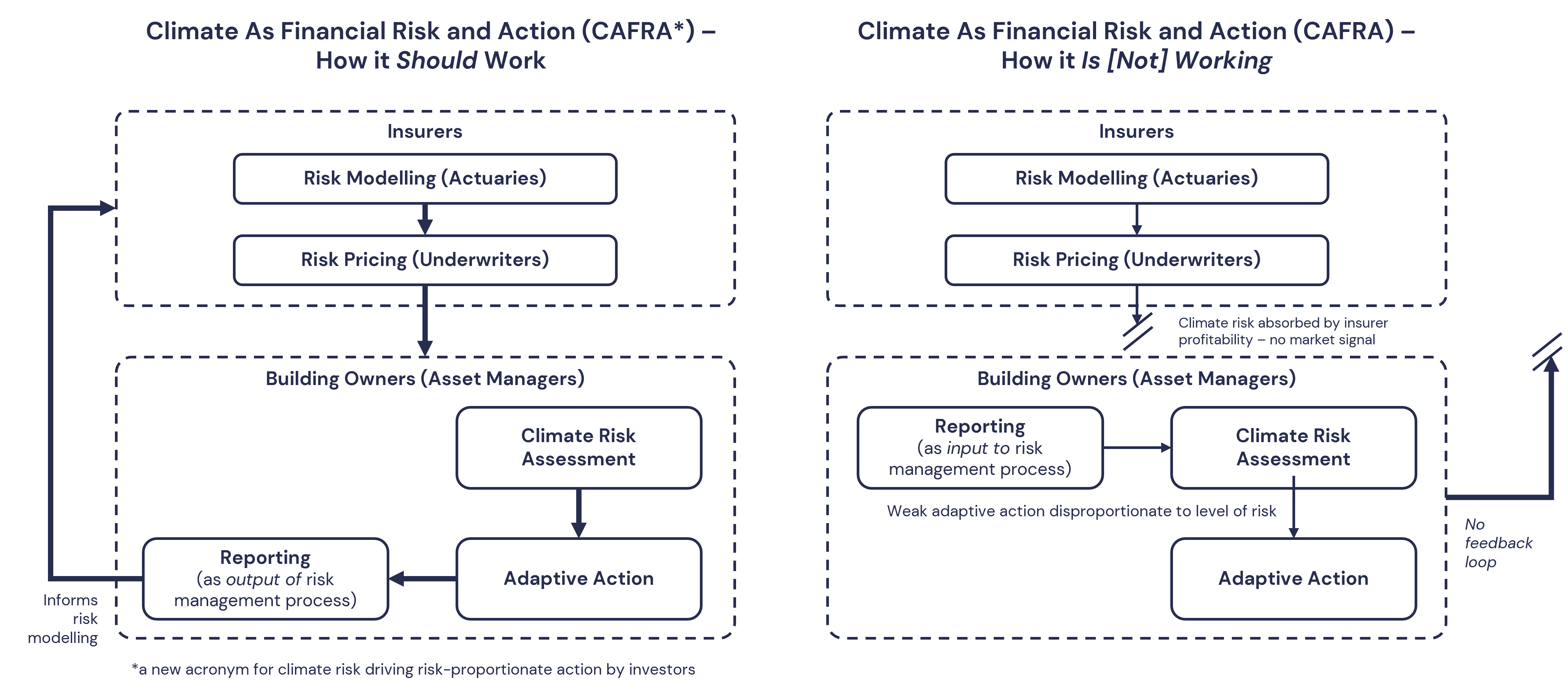
At LCAW, there was general agreement of the materiality of climate risks to real estate & infrastructure investors, but a recognition that investors are not sufficiently incentivised to manage climate risk at the financial level. The critical intermediary here is the insurance sector – while actuaries agree that climate risk is material, the current ‘soft’ conditions arising from sustained insurer profitability is inhibiting the need for insurers to start accounting for this risk in premia. With insurers as they key ‘cog’ translating climate risk to financial risk, real estate & infrastructure investors – who are disproportionately exposed to physical risk – are simply not receiving market signals that climate risk is indeed financial risk. Instead, climate risk management exercises continue to be driven by reporting frameworks such as ISSB (formerly TCFD) and GRESB, leading to a focus on the identification of risk through regular assessment, rather than the management of those risks as material. The key takeaway here is that until the insurance sector begins to harden, climate-risk-as-financial-risk signalling will remain weak and the focus on assessment will continue to dominate.
Asset focus is limiting strategic responses to collective risks
For asset managers, the current implementation model for climate resilience measures is very much at the asset level, where their responsibilities begin and end. Valuable work can be delivered at this level, such as design/engineering solutions to mitigate the impact of extreme heat on occupants, or to attenuate water runoff during increasingly frequent storms. Physical climate risks by and large exist at the macro scale, however – and a focus on asset-level implementation is accordingly highly inefficient. The Thames Barrier presents a useful analogy – imagine a world whereby, instead of collective defence engineering at the point of greatest influence, each building in London’s flood zone had its own individual flood defences. Not only would this be hugely expensive to build, but it would be close to impossible to maintain, monitor, repair and improve. This is the situation we are facing with the current focus on asset-level resilience measures.
Investors with a focus on assets in built-up areas – i.e. with a diverse asset ownership pool and collective exposure to climate risks – should continue to assess climate risk at the asset level, but resilience measures may be more effectively financed and implemented through collective approaches such as climate resilience bonds. Since these are public good investments, these should by nature be based on blended finance initiatives representing the confluence between public & private interests. This is very much an emerging area, with very few to zero examples of real estate asset managers getting involved in collective resilience financing. One notable recent example outside of real estate include the €300m Tokyo Resilience Bond, which was issued by the Tokyo Municipal Government to invest in city-level resilience projects to a 700% oversubscription rate; real estate managers should look to examples like this to think strategically about hedging climate risks at the portfolio level.
Data, software & AI; frameworks; other takeaways from LCAW
Even amidst the focus on climate, it’s difficult to escape the tentacles of AI finding their way into every discussion. Lots of panels – especially those stacked with climate data SaaS players – found themselves challenged on relevance given how easy it is now to spin up a data management system in minutes. At this point, it seems that managers are increasingly focused on the quality of the data itself, its ability to integrate with their own reporting and risk management flows, then a shiny UI with limited data capabilities and constraints on adapting to managers’ bespoke requirements.
Discussion of the NZAMI relaunch from earlier this year focused on the relevance of ESG coalitions and frameworks in the era of private markets – with much of the ESG investment ecosystem having been formulated in an area when private markets were in relative infancy, there is a need for a fundamental rethink of how investors can be incentivised to allocate capital to sustainability projects.